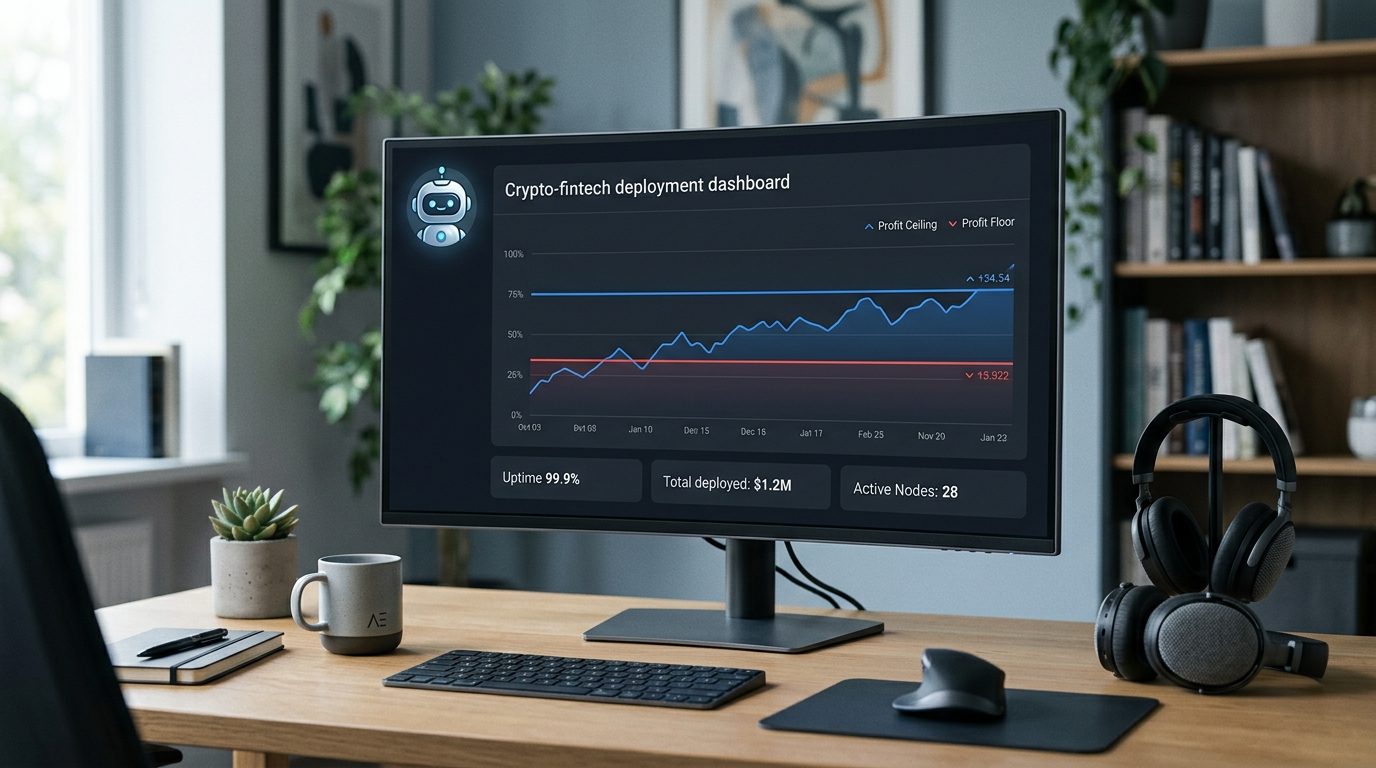
Deploying capital into crypto markets doesn't need to be a maze of spreadsheets, signal channels, and sleepless decision-making. For many users the barrier isn't knowledge—it's process complexity. This article breaks down a straightforward approach to start deploying in crypto with disciplined risk controls, automated tools, and clear guardrails such as Profit Floor and Profit Ceiling.
Why simple deployments outperform complicated ones
Complex strategies often promise higher returns, but they compound execution risk: more parameters, more assumptions, and more ways for the plan to fail. In volatile markets, simple, repeatable deployments tend to be superior because they're easier to monitor, stress-test, and automate.
When your objective is consistent performance rather than headline-grabbing wins, simplicity helps you maintain discipline and avoid common errors like overleveraging, mis-timing, or duplicating exposures across strategies.
Recognizing the real problems people face when starting out
New deployers often struggle with the following:
- Decision paralysis from too many indicators and strategies.
- Poor risk controls or vague exit rules.
- Operational complexity—manual execution across exchanges and wallets.
- Difficulty translating backtests to live performance.
- Over-optimization that works historically but fails in new market regimes.
Addressing these problems requires a clear deployment framework, effective tools to automate execution, and a repeatable risk management approach.
Core components of a streamlined deployment framework
A practical framework has five elements:
- Define the objective: Are you targeting steady yield, directional exposure, volatility harvesting, or portfolio diversification?
- Set risk limits: Use position sizing, maximum drawdown, and Profit Floor/Profit Ceiling thresholds.
- Choose a strategy tier: Simple (e.g., dollar-cost averaging, trend following), intermediate (mean reversion, volatility capture), or advanced (multi-factor robo strategies).
- Automate execution: Use robust robots that connect to exchanges, enforce rules, and record performance.
- Monitor and iterate: Review outcomes on a schedule and adjust only when supported by evidence.
Practical first deployments you can start with today
Begin with strategies that are inherently low-friction and easy to explain:
- Scheduled Deployments: Regularly allocate a fixed amount into selected assets—this reduces timing risk and simplifies psychology.
- Trend-following Robot: Captures extended moves with disciplined cutoffs and position sizing rules.
- Volatility Capture: Use directional-neutral strategies to harvest short-term volatility while protecting net exposure.
These strategies map directly to Active Deployment modes—set clear start conditions, profit-taking limits, and stop-loss thresholds so the robot can act without manual intervention.
Why Profit Floor and Profit Ceiling matter
Profit Floor is your minimum acceptable outcome for a deployment—an automated guardrail that locks in gains or limits downside. Profit Ceiling is the pre-defined point where you realize gains and re-evaluate the next step. Together they create a controlled band for performance and prevent emotional trade management.
Example: a trend-following robot can be configured to raise the Profit Floor as the deployment accumulates gains, protecting winners while allowing room for further upside until the Profit Ceiling is reached. This combination reduces the chance of losing accrued profits during whipsaws.
How automation and robots simplify the operational burden
Automation removes manual friction: it executes orders quickly, enforces rules precisely, and logs every action for auditability. Rather than juggling exchange credentials and spreadsheets, you delegate routine tasks to robots and focus on higher-level decisions.
Good robots do three things well: reliable connectivity to exchanges, deterministic rule execution, and transparent performance reporting. They enable Active Deployment at scale with consistent behavior across market regimes.
The role of AI in modern deployment strategies
AI is a force multiplier when used appropriately. Where it excels is in pattern recognition, adaptive parameter tuning, and risk-scenario classification. AI can surface regime changes, adjust strategy aggression, and help tune position sizing based on realized volatility.
However, AI is not a magic button. Models must be interpretable, stress-tested, and combined with human oversight. Use AI to augment decision-making and automation, not to replace deterministic risk rules like Profit Floor or stop conditions.
How EXVENTA helps you start deploying without the complexity
EXVENTA provides a platform designed for users who want to Start Deploying quickly and with robust controls:
- Curated robots: A library of vetted robots you can Explore Robots to match your objective—directional exposure, volatility harvesting, or balanced deployment.
- Built-in risk controls: Profit Floor and Profit Ceiling settings, drawdown limits, and position sizing templates you can apply out of the box.
- Active Deployment interfaces: Clear dashboards for launching, pausing, and reviewing deployments without manual scripting.
- Transparent performance: Live logs and historical analytics that help you validate strategy behavior under different market regimes.
To get started right now, explore available robots on the platform: Explore Robots. If you want to compare strategy options side-by-side, use the comparison tool at Compare.
Step-by-step: A minimal lifecycle to start deploying
- Register and secure an account: Create an account at EXVENTA and enable two-factor authentication.
- Define your deployment objective: Choose one clear goal (e.g., steady yield or trend exposure).
- Pick a robot or strategy: Browse robots that match your objective and risk profile.
- Set risk parameters: Configure Profit Floor, Profit Ceiling, position size, and maximum drawdown.
- Start Deploying: Launch a small Active Deployment to validate behavior in live conditions.
- Monitor and adapt: Use the EXVENTA dashboard to track performance and adjust only when you have clear evidence.
Benefits of starting simple with EXVENTA
- Predictable rule-based deployments that reduce emotional trading.
- Lower operational complexity—automated execution and consolidated reporting.
- Clear risk controls with Profit Floor and Profit Ceiling to protect gains and limit losses.
- Faster time-to-market for new strategies through ready-made robots.
- Ability to scale multiple Active Deployment lanes without doubling manual work.
Important risk considerations before you deploy
No deployment is without risk. Be mindful of:
- Market volatility: Rapid price moves can produce slippage and unexpected drawdowns.
- Model risk: Past performance is not a guarantee of future outcomes; avoid overfitting strategies to historical data.
- Operational risk: API connectivity issues, exchange outages, and execution delays can affect outcomes.
- Concentration risk: Overlapping strategies or correlated assets can amplify loss exposure.
- Counterparty risk: Use trusted exchanges and secure your keys; maintain withdrawal limits where appropriate.
Mitigate these risks by starting small, using stop and limit mechanics, diversifying strategy types, and keeping a clear audit trail of deployments.
Measuring success: what to track after you start deploying
Use a concise set of metrics to assess whether a deployment meets expectations:
- Net return over defined periods.
- Maximum drawdown relative to initial allocation.
- Sharpe-like ratio adjusted for crypto volatility.
- Win/loss rate and average gain/loss per trade.
- Time spent in market versus idle periods.
EXVENTA's dashboards present these metrics so you can compare deployments, spot regime shifts, and make evidence-based changes.
When to iterate and when to leave well enough alone
Change a deployment only when you have sufficient data and a clear hypothesis. Small, frequent tweaks often add noise; structural changes—like a market regime shift or a new risk constraint—justify reconfiguration. Maintain an iteration log so you can correlate changes with performance outcomes.
Conclusion: Start Deploying with discipline, not drama
Starting to deploy in crypto is less about finding the perfect strategy and more about establishing a repeatable, low-friction process with strong risk controls. Use Profit Floor and Profit Ceiling to protect outcomes, automate execution with vetted robots, and let AI enhance—not replace—your risk rules.
If you’re ready to move from consideration to action, register on EXVENTA, Explore Robots, and begin an Active Deployment with clear, measurable rules. Existing users can log in to launch immediately.
Questions people frequently ask before they deploy
How much capital do I need to start deploying?
There’s no universal minimum, but start with an amount you can afford to allocate while you validate the strategy. Small initial allocations reduce operational risk and let you observe live behavior without large downside exposure.
Can robots handle multiple exchanges and assets?
Yes. EXVENTA robots are designed to connect to multiple exchanges where supported, enabling diversified Active Deployment across assets without manual order routing.
How do I set an appropriate Profit Floor and Profit Ceiling?
Profit Floor should reflect the minimum acceptable gain or the drawdown limit you won’t tolerate. Profit Ceiling represents a target where you lock in gains and reassess. Start conservative, monitor outcomes, and adjust based on realized volatility and strategy behavior.
Does AI mean I can be hands-off entirely?
AI helps with pattern detection and adaptive tuning, but human oversight is essential. Keep deterministic risk rules in place, and periodically review AI-driven adjustments to ensure they align with your objectives.
How should I validate a robot before launching live?
Review historical performance, understand the strategy’s logic, and run a small Active Deployment to observe live execution. Check connectivity, slippage, and how the robot enforces Profit Floor and Profit Ceiling settings.
Where can I learn more about different deployment strategies?
EXVENTA’s resource center offers concise content and walkthroughs—start at Education and review platform mechanics on our FAQ page. If you want to compare robots side-by-side, use Compare.
How do I begin right now?
Create an account at EXVENTA, browse the robot library at Explore Robots, configure risk controls including Profit Floor and Profit Ceiling, and Start Deploying with a small Active Deployment.
Well-executed deployments are the product of clear rules, disciplined automation, and continuous but measured oversight. Follow the steps above to build a deployment process that scales without adding unnecessary complexity.