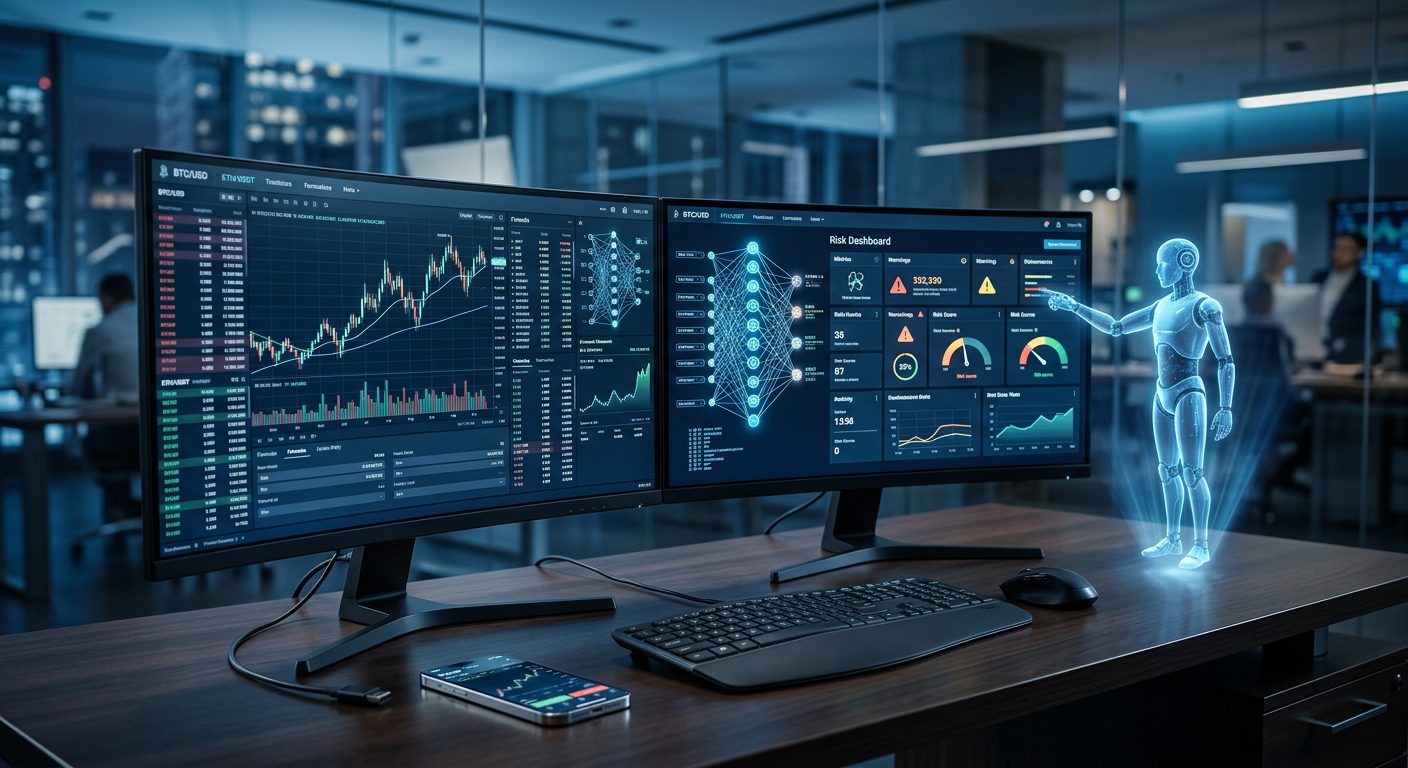
Why the debate between AI trading and manual trading still matters
The rise of algorithmic systems has rewritten many rules of market engagement, but the core question remains: do machines beat humans when it comes to deploying crypto capital? The answer isn't binary. Both approaches have clear strengths and trade-offs. This article parses those differences with practical frameworks you can use when deciding between an AI-driven deployment and hands-on manual trading.
What’s actually at stake when you choose a method
Choosing between AI trading and manual trading affects three measurable outcomes: execution quality, risk control, and scalability. Execution quality determines how close your fills are to ideal prices. Risk control governs drawdowns, volatility, and exposure management. Scalability is about how much capital and how many markets you can realistically manage.
Defining terms in a practical way
- AI trading: systems that use algorithms, statistical models, and machine learning to generate signals and execute orders with minimal human intervention.
- Manual trading: human-led decision-making where traders analyze markets, enter and exit positions, and manage risk primarily through discretion.
- Deployment: the act of allocating capital and initiating a trading strategy on live markets.
Problem framing: why a simple comparison is misleading
People often frame this as a competition—AI versus human—but that misses the point. Markets are complex adaptive systems. Success depends less on whether a human or machine makes decisions and more on the process around decision-making: data quality, execution infrastructure, risk controls, and the discipline to respect pre-defined Profit Floor and Profit Ceiling constraints.
To evaluate the two approaches properly, consider the following questions:
- Can the method sustain consistent execution under stress?
- Does it preserve capital during extreme market moves?
- Is it scalable across assets and capital size?
- How transparent and auditable are its decisions?
How AI trading outperforms manual trading—where machines excel
AI and automated systems bring three structural advantages.
- Speed and execution: Algorithms can monitor tens or hundreds of markets simultaneously and execute orders within milliseconds, reducing slippage and taking advantage of fleeting opportunities.
- Consistency: Machines follow rules without fatigue, emotion, or bias. That consistency enforces Risk Management frameworks like fixed Profit Floor thresholds and Profit Ceiling targets without discretionary deviation.
- Data scale and pattern recognition: Advanced models spot statistical relationships across high-dimensional data that are invisible to unaided human analysis, enabling systematic alpha capture where it exists.
When markets are liquid and patterns are stable, AI-driven deployments can outperform manual trading on execution, drawdown control, and compound return over time.
Where manual trading keeps an edge
Humans retain advantages in environments characterized by structural shifts, limited data, or opaque events. Consider these areas:
- Contextual judgment: Narrative shifts—regulatory announcements, hacks, or macro shocks—often require flexible judgment and hypothesis testing that aren’t encoded in pre-trained models.
- Adaptation to regime changes: Humans can detect novel regimes early and adapt the deployment approach without retraining the model.
- Creative strategy development: Traders can invent or combine strategies from different domains—options overlays, discretionary macro hedges, or bespoke position sizing—that are harder to automate reliably.
Manual trading shines in tail-edge scenarios where nuance and contextual reasoning matter more than raw speed.
Deep insights: hybrid approaches often outperform pure strategies
The practical truth for most serious deployers is hybrid models—which combine AI-driven execution with human oversight—typically deliver the best risk-adjusted outcomes. A hybrid deployment leverages the speed and scale of algorithms for routine execution while preserving human judgment for regime detection, strategy selection, and exceptions management.
Key design patterns for hybrids include:
- Signal generation by AI, oversight by humans: Models propose trades; humans approve, modify, or veto based on situational context.
- Automated execution with manual thresholds: Systems execute within pre-set Profit Floor and Profit Ceiling bands but pause for human intervention during extreme volatility.
- Parallel testing: Run AI strategies in Active Deployment alongside manual allocations to compare real-time performance and correlations, then iterate.
The role of AI in modern trading — beyond speed and pattern-finding
AI in trading is no longer just about chasing micro-arbitrage. It now encompasses robust areas that materially affect deployment outcomes:
- Risk modeling: Probabilistic forecasts and scenario generation improve stress-testing and position sizing.
- Adaptive execution algorithms: AI can minimize market impact by dynamically slicing orders and learning optimal execution patterns across venues.
- Anomaly detection: Real-time monitoring for exchange outages, suspicious orderbooks, or sudden liquidity gaps that should trigger automated safety protocols.
These capabilities transform a trading strategy into a resilient system that can protect capital and preserve optionality through turbulent markets.
How EXVENTA aligns AI strengths with human judgment
EXVENTA is built to make hybrid deployments straightforward and governance-friendly. The platform provides tools that let you Explore Robots, run Active Deployment scenarios, and compare strategies with side-by-side metrics at /compare.
Practical ways EXVENTA helps you deploy better:
- Turnkey algorithmic engines: Select from vetted robots that can execute consistent strategies across multiple exchanges while respecting configurable Profit Floor and Profit Ceiling constraints.
- Human-in-the-loop controls: Set intervention thresholds so models pause for review when certain volatility or drawdown triggers occur.
- Transparent performance dashboards: Real-time P&L, risk metrics, and audit logs make it easy to attribute performance and refine deployments.
- Managed execution layer: Reduce slippage and fragmentation with execution algorithms tuned for crypto markets.
If you’re evaluating whether to automate, start by learning the mechanics and then Start Deploying with a controlled budget. Existing users can login to configure their first hybrid deployment.
Practical benefits of automation you can measure
- Lower execution costs: Reduced slippage and faster fills lead to tighter realized spreads.
- Consistent application of risk rules: Enforce Profit Floor protections and position limits without manual error.
- Scalable oversight: One operator can supervise many automated deployments across assets and strategies.
- Continuous learning: Machines can adapt to microstructure changes more quickly when supported with proper data flows.
Risk awareness: what automation doesn’t solve
Automation is powerful but not infallible. Deployers must recognize these risks before scaling up:
- Model risk: Overfitting and stale models perform poorly when regimes shift. Regular retraining and cross-validation are essential.
- Execution risk: API failures, exchange outages, and network latency can lead to partial fills and unintended exposure.
- Liquidity risk: In low-liquidity markets, automated strategies may move price against themselves, increasing costs.
- Operational risk: Misconfigured parameters, forgotten automation, or insufficient monitoring can create outsized losses.
- Security risk: API key management and account security must be handled with enterprise-grade controls.
EXVENTA mitigates many of these risks through layered controls, thorough logging, and safety thresholds. Visit our FAQ to learn more about security and governance best practices.
When to choose AI, manual, or a hybrid deployment
Use this decision heuristic:
- AI-first: High-frequency, liquid markets where consistent execution and scale matter most.
- Manual-first: Complex, low-liquidity scenarios or thematic macro bets requiring discretionary judgment.
- Hybrid: Most professional deployers—use AI for routine execution and humans for strategy selection, monitoring, and regime response.
Hybrid deployments unlock the most realistic path to improving returns while managing downside through enforceable Profit Floor rules.
How to start a controlled transition to automation
Start with a small, measurable Active Deployment. Steps to follow:
- Define clear success metrics (Sharpe, max drawdown, realized slippage, time in market).
- Deploy with conservative position sizes and explicit Profit Floor/Profit Ceiling rules.
- Run AI strategies in parallel with manual positions to understand correlation structures.
- Iterate based on live performance and maintain a cadence for retraining or parameter updates.
EXVENTA’s platform supports each step: from strategy selection to execution and monitoring. Explore available robots at /robots and compare outcomes at /compare.
Conclusion: there is no universal winner—only the right deployment
AI trading and manual trading each have clear domains of superiority. Machines win on speed, consistency, and scalability. Humans win on context, creativity, and regime detection. The highest probability path to durable results is a hybrid approach that combines algorithmic execution with human oversight and well-defined Profit Floor and Profit Ceiling guardrails.
If you want to experiment with hybrid deployments, EXVENTA offers the infrastructure, vetted robots, and governance tools to Start Deploying with confidence. Explore available options at /robots or Start Deploying today.
Frequently asked questions
1. Can AI trading completely replace manual traders?
Not entirely. AI can automate routine execution and risk enforcement, but manual judgment remains crucial for regime shifts, novel events, and strategy innovation. The most robust deployments combine both.
2. How does EXVENTA enforce Profit Floor and Profit Ceiling rules?
EXVENTA provides configurable safety thresholds that trigger automated actions—pauses, hedges, or exits—when P&L crosses predefined Profit Floor or Profit Ceiling levels. These controls are auditable and adjustable by the user.
3. What safeguards prevent an automated strategy from running amok?
Layered safeguards include kill-switches, human-in-the-loop triggers, rate limits, and anomaly detection. EXVENTA also logs every decision so you can review and refine parameters.
4. Is automation safe for small deployers or only for institutions?
Automation scales. Small deployers can use conservative robots and Active Deployment modes to test strategies with limited capital before scaling up. EXVENTA’s onboarding and education resources at /education help shorten the learning curve.
5. How do I compare robot performance before deploying capital?
Use EXVENTA’s comparison tools to view historical metrics, drawdowns, and correlations across robots. Visit /compare to run side-by-side analyses and align strategy choice with your risk profile.
6. What are the top operational risks to monitor in automated deployments?
Monitor model drift, exchange connectivity, API key security, order routing inefficiencies, and liquidity conditions. Regular audits and robust monitoring dashboards are essential.
7. How do I begin a hybrid deployment on EXVENTA?
Start by exploring robots at /robots, review education material at /education, then register to configure your first Active Deployment at /register. If you’re already a user, login to set up human-in-the-loop thresholds and monitoring alerts.